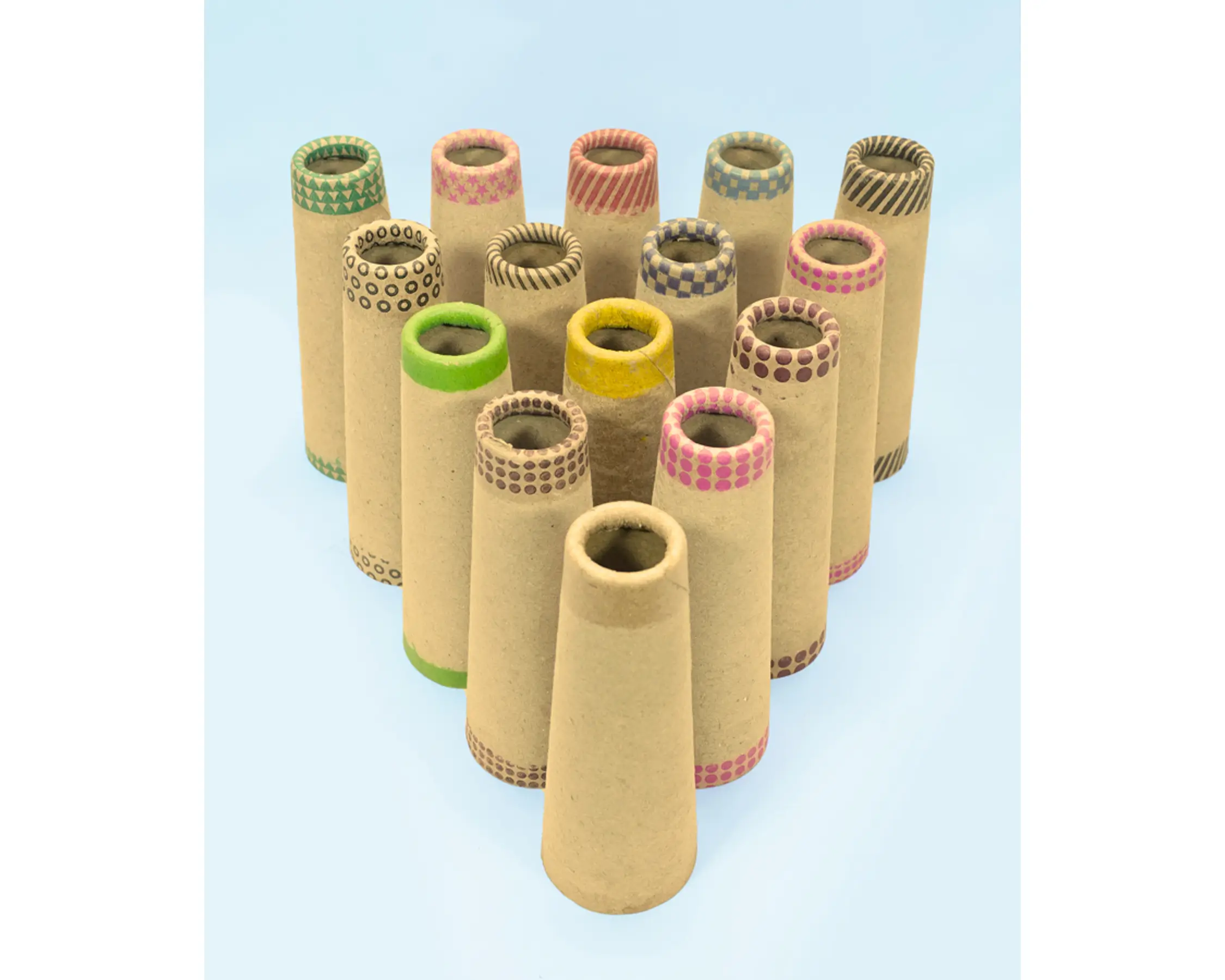
Spinning mills often assume a single paper cone specification can handle all yarn varieties. In practice, cotton yarn and polyester/synthetic yarns exhibit completely opposite physical properties during high-speed winding, requiring distinct cone geometry, crush ratings, and surface treatments.
1. Tension Dynamics & Compressive Hoop Stress
The primary mechanical difference between cotton and polyester yarn winding lies in compressive hoop stress. When 100% cotton yarn is wound, the fiber has an elongation at break of approximately 5% to 7% with minimal elastic recovery. As a result, the compressive pressure exerted on the paper cone core remains stable over time.
Polyester, however, possesses elastic elongation ranging from 15% to 30%. When wound under autoconer tension (12 to 20 cN), the polyester yarn coils stretch. Once on the cone, these coils attempt to relax and contract back to their original length, creating massive cumulative inward pressure known as hoop stress. If an ordinary cotton-grade paper cone is used, this compressive force can easily crush the cone core, leading to package jamming on the winding drum.
2. Surface Friction & Velvet Flocking
Yarn stability on a paper cone is determined by the coefficient of friction between the paper surface and the yarn coils:
- Cotton Yarns: Natural cotton fibers feature natural convolutions that provide intrinsic mechanical interlock. Cotton cones require an ultra-smooth velvet finish that holds the yarn during start-up but releases it without fiber abrasion or lint buildup during knitting creel takeoff.
- Polyester & Blended Yarns: Synthetic filament and spun polyester yarns are inherently slippery. Without sufficient surface grip, the outer yarn coils slide downward over lower layers, causing slough-offs and package deformation. For polyester yarns, Craftwave applies micro-grooved velvet flocking and embossed circular rings that anchor the initial coils firmly.
3. Transfer Tail Grooves and Reserve Notches
Modern shuttleless weaving mills (air-jet and rapier) operate continuous magazine creels where the tail of one yarn package is spliced to the leading end of the next. To prevent yarn slippage during transit and package handling:
Cotton cones typically utilize a single bottom groove or a small V-notch. In contrast, polyester and synthetic cones require double or triple reinforced grooves and deep Y or U-notches to capture the elastic transfer tail firmly, preventing it from snapping back into the yarn body.
4. Comparative Requirements Overview
| Parameter | Cotton Yarn Cones | Polyester & Blended Yarn Cones |
|---|---|---|
| Recommended Taper Angle | 5° 57′ Standard | 4° 20′ Reinforced |
| Radial Crush Requirement | > 700 N – 750 N | > 780 N – 850 N (Heavy Duty) |
| Surface Texture | Smooth Velvet / Flocked | High-Traction Flocked with Anti-Slip Grooves |
| Moisture Content | 6% – 8% Equilibrium | 6% – 7% Stabilized (Heat Sealed) |
| Nose Configuration | Smooth Bull Nose (Snag-Free) | Crimped Bull Nose with Deep Reserve Notch |
| Primary Mill Machine | Ring spinning autoconers & knitting frames | Autoconers, TFO twisters & air-jet creels |
5. Optimizing Mill Economics with Calibrated Cones
Using the correct carrier for each fiber category eliminates spindle downtime, reduces waste yarn, and protects spinning mills against costly export quality rejections. Craftwave & Company manufactures calibrated 5° 57′ cotton cones and 4° 20′ synthetic cones in our automated Gujarat production facility, with free test batches available for spinning mill trials worldwide.
Frequently Asked Questions
Craftwave & Company Technical QA Lab
Manufacturer of high-precision paper cones in Chhapra, Rajkot district, Gujarat, India. Supplying spinning mills across India and global yarn export hubs.
Need Calibrated Paper Cones for Your Spinning Mill?
Request 100 to 500 free trial samples of our 5° 57′ or 4° 20′ paper cones to test dynamic concentricity and crush strength on your high-speed autoconers.