1. Spindle Dynamics at 20,000+ RPM: The Critical Role of Yarn Carriers
Modern automated winding machines—such as Savio Polar/EcoPulsarS, Murata Process Coner QPRO, and Schlafhorst Autoconer 5/6/X5—operate at blistering winding speeds of 1,200 to 1,800 meters per minute. At these high-velocity thresholds, any micro-deviation in cone concentricity creates eccentric centrifugal forces that cause spindle vibration.
When an uncalibrated cone wobbles on the winding spindle, three immediate points of failure occur:
- Uneven Yarn Tension: The traverse mechanism fails to lay yarn evenly across the cone face, creating "soft spots" and saddle-shaped packages.
- End-Breaks & Autoconer Stoppages: Spindle vibration triggers sensitive electronic yarn clearers, causing needless cuts and splicing delays.
- Bearing & Spindle Wear: Continual dynamic imbalance prematurely degrades high-speed winder bearings, driving up mechanical maintenance costs.
Engineering Fact from Craftwave Quality Lab
Craftwave & Company manufactures paper cones with concentricity tolerances calibrated to within ±0.15mm. This dynamic balance guarantees vibration-free operation on high-speed spindles up to 22,000 RPM.
2. Conicity & Taper Angles: Matching Cones to Yarn Types
Choosing the right taper angle is the most critical decision in spinning packaging design. The taper angle determines how smoothly the yarn balloon unwinds during high-speed warping, circular knitting, or shuttleless weaving.
| Taper Angle | Common Yarn Applications | Recommended Count Range | Downstream Process |
|---|---|---|---|
| 5° 57' (Standard Cotton) IS 4888 Part 3 / ISO 8489-5 |
100% Carded & Combed Cotton | Ne 20s to Ne 60s | High-Speed Circular Knitting & Weaving |
| 4° 20' (Medium Blend) IS 4888 Part 2 / ISO 8489-3 |
Polyester-Cotton (PC), Modal, Viscose & Blends | Ne 30s to Ne 80s | Air-Jet & Rapier Shuttleless Weaving |
| 3° 30' (Shallow Rotor/OE) IS 4888 Part 1 / ISO 8489-2 |
Heavy Count Cotton, Open-End (OE) Rotor Yarn | Ne 6s to Ne 16s | Denim, Terry Towel, Canvas & Twisting |
| 9° 15' (Steep Filament) ISO 8489-6 Standard |
Continuous Filament (DTY/FDY), Silk, Synthetics | Denier 50D to 150D | TFO Twisting, Texturizing & Warping |
3. Paper Mill Raw Material Sourcing & Radial Crush Resistance
As hundreds of layers of yarn are wound under tension on autoconers, immense cumulative compressive force is exerted inwards onto the cone body. In continuous filament or high-twist cotton yarns, synthetic shrinkage forces can reach over 400 kgf.
Inferior paper cones crush inward under this radial pressure, distorting the internal bore diameter. When the weaver or knitter attempts to mount the cone onto their creel spindle, the deformed cone fails to fit or jams, resulting in rejected yarn consignments.
To eliminate inward bore collapse, Craftwave & Company sources high-density Cone Board (180 to 450 GSM, Burst Factor 22–35, Cobb Value 30–50 g/m²) directly from certified paper mills. During paper mill production, multi-ply virgin unbleached pulp fibers are aligned with high cross-directional stiffness and calibrated porosity.
Conversion & Multi-Zone Moisture Curing:
Master paper mill reels are precision-slit into trapezoidal blanks and spiral-wound under pneumatic pressure with food-grade dextrin adhesives. The cones then pass through automated multi-zone hot-air drying chambers to achieve a stabilized Equilibrium Moisture Content of 6% to 8% (EMC), preventing post-manufacturing distortion and delivering verified radial crush resistance exceeding 750 N (ISO 12048).
4. Surface Texture, Embossing & Groove Friction
The surface finish of a paper cone must satisfy two conflicting engineering requirements across modern high-speed textile spinning mills:
- High Initial Grip: During the start of winding, the empty cone must grip the yarn tail instantly without slippage.
- Zero Unwinding Friction: When the consumer mill unwinds the package at 1,000 m/min, the yarn must release effortlessly without snagging on surface paper burrs.
To achieve this balance, Craftwave cones feature:
- Diamond Micro-Embossing: Calibrated micro-pyramids that anchor the yarn base securely.
- Precision Bull-Nose & Rounded Bases: Eliminates sharp edge tears on the yarn traverse limits.
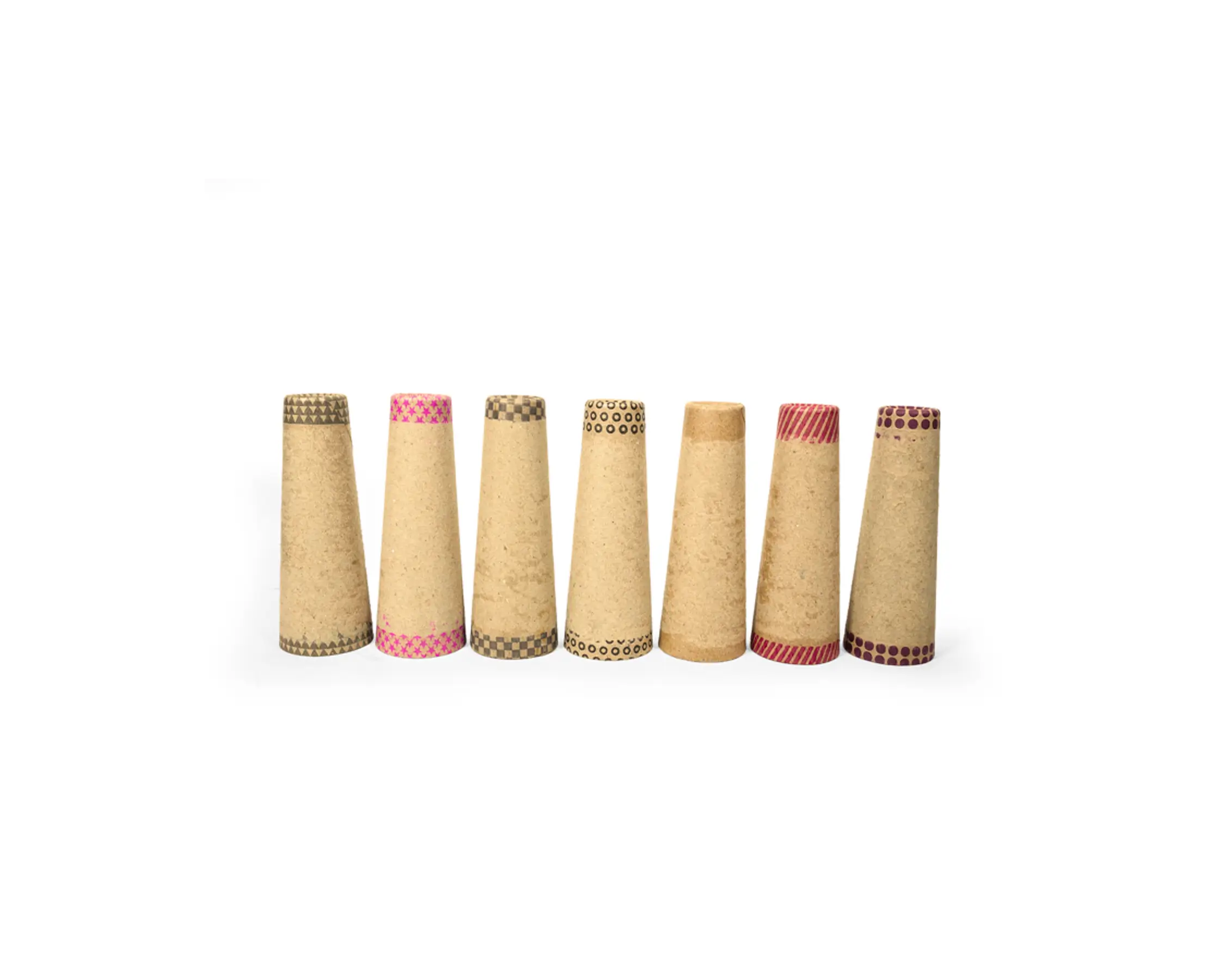
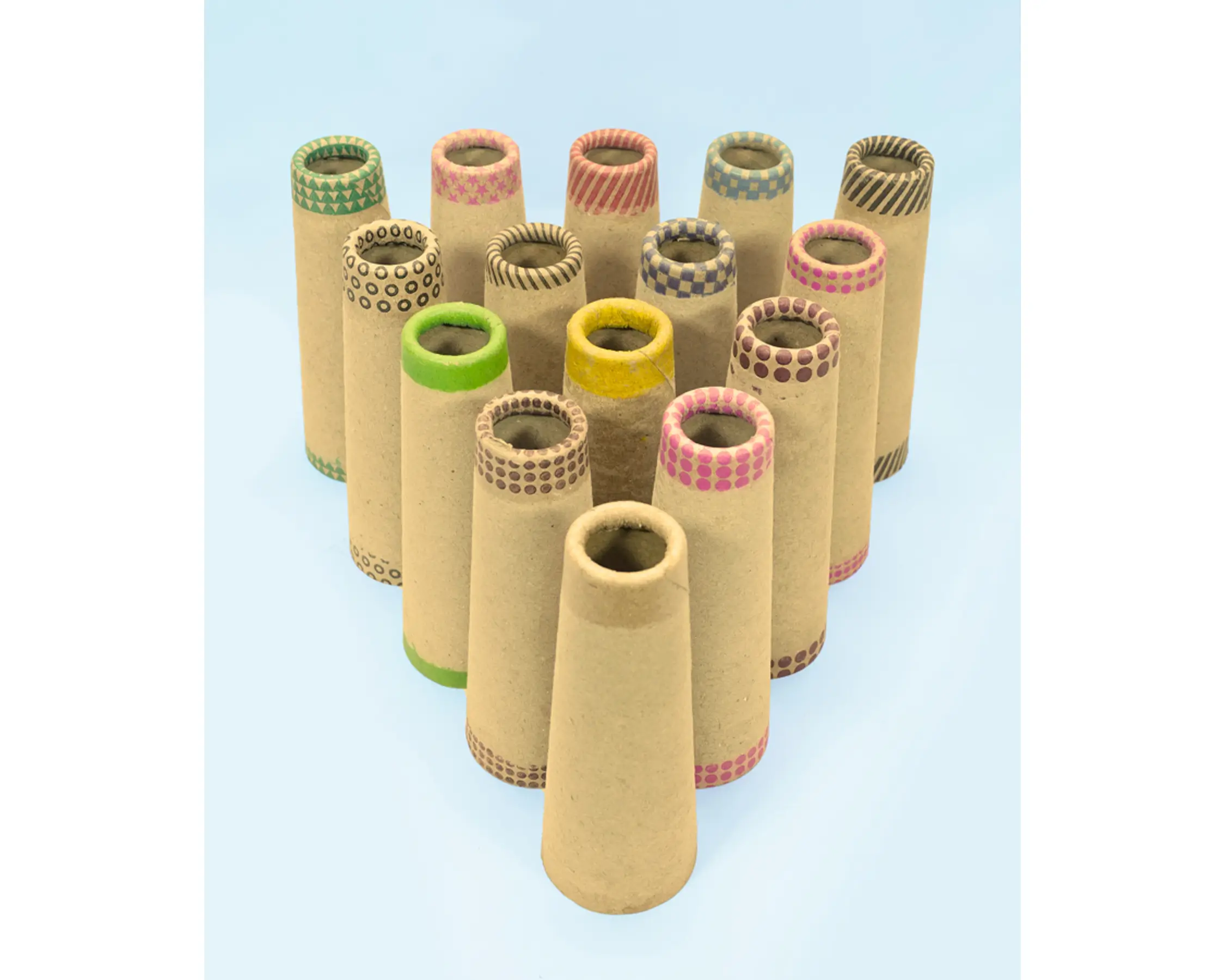
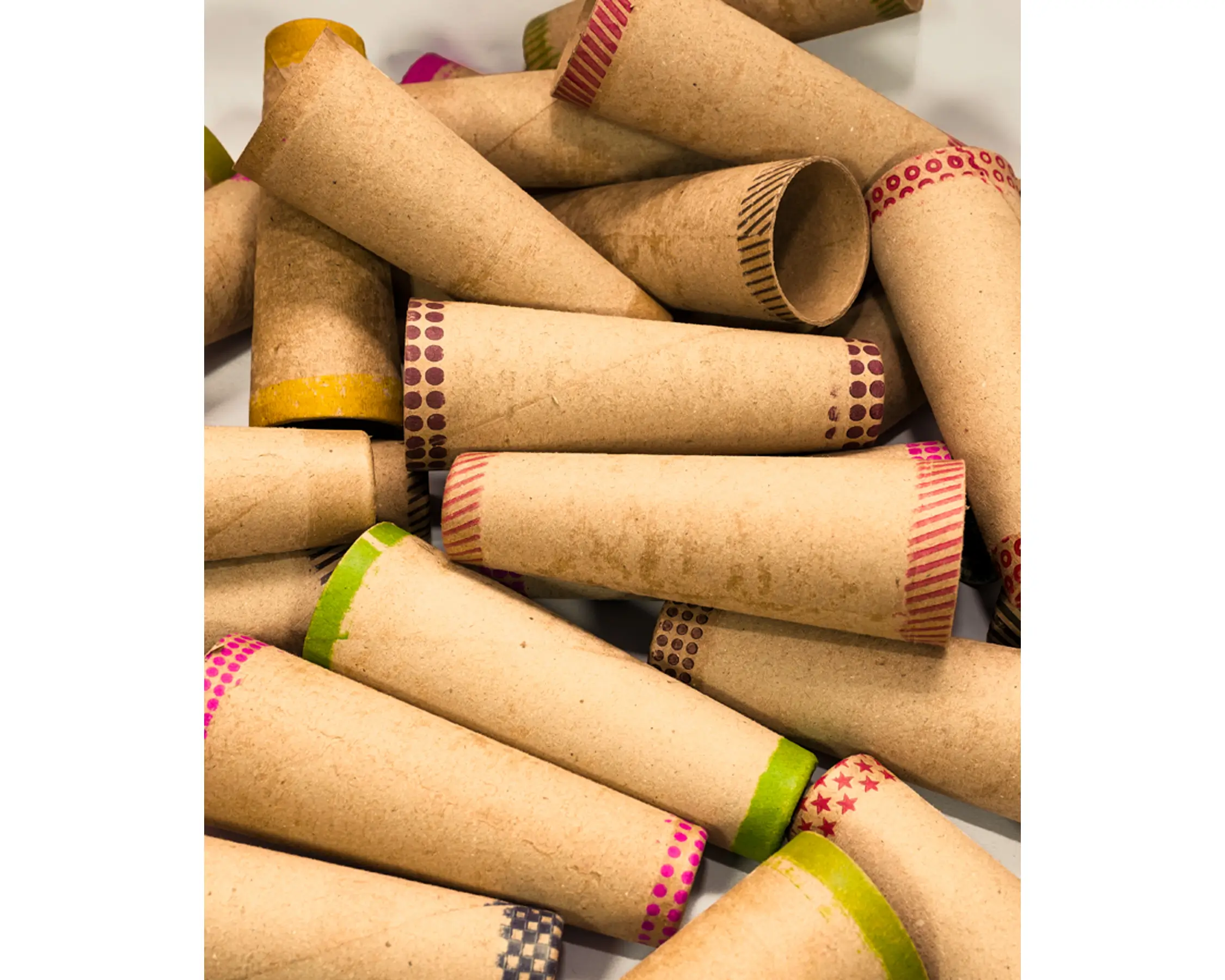
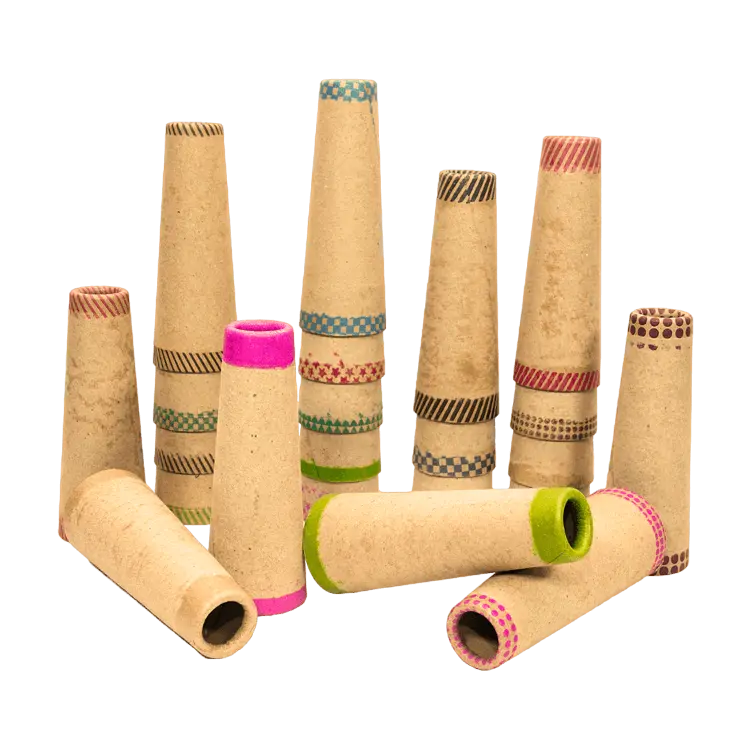
- Color-Coded Identification Tips: Allows mill operators to identify yarn counts instantly (e.g., Red for 30s, Green for 40s, Yellow for 60s).
5. Sustainability & ESG Compliance for Global Textile Exports
International buyers in Europe, the USA, and Japan are enforcing stringent supply chain decarbonization standards under the EU Corporate Sustainability Due Diligence Directive (CSDDD). Textile mills exporting to global apparel brands are phasing out non-biodegradable plastic bobbins in favor of 100% biodegradable and recyclable paper carriers.
By partnering with Craftwave & Company, textile mills achieve:
- 100% Recyclable Packaging: Manufactured from FSC-aligned kraft paper fibers.
- Zero Toxic Chemical Adhesives: Utilizing water-based starch adhesives compliant with REACH and OEKO-TEX standards.
- Tare Weight Optimization: 25% lighter than rigid plastic equivalents, reducing container freight emissions.
Optimize Your Mill's Paper Cone Specifications
Consult directly with Craftwave engineers for custom cone taper dimensions, surface embossing, and free spinning mill sample trials.