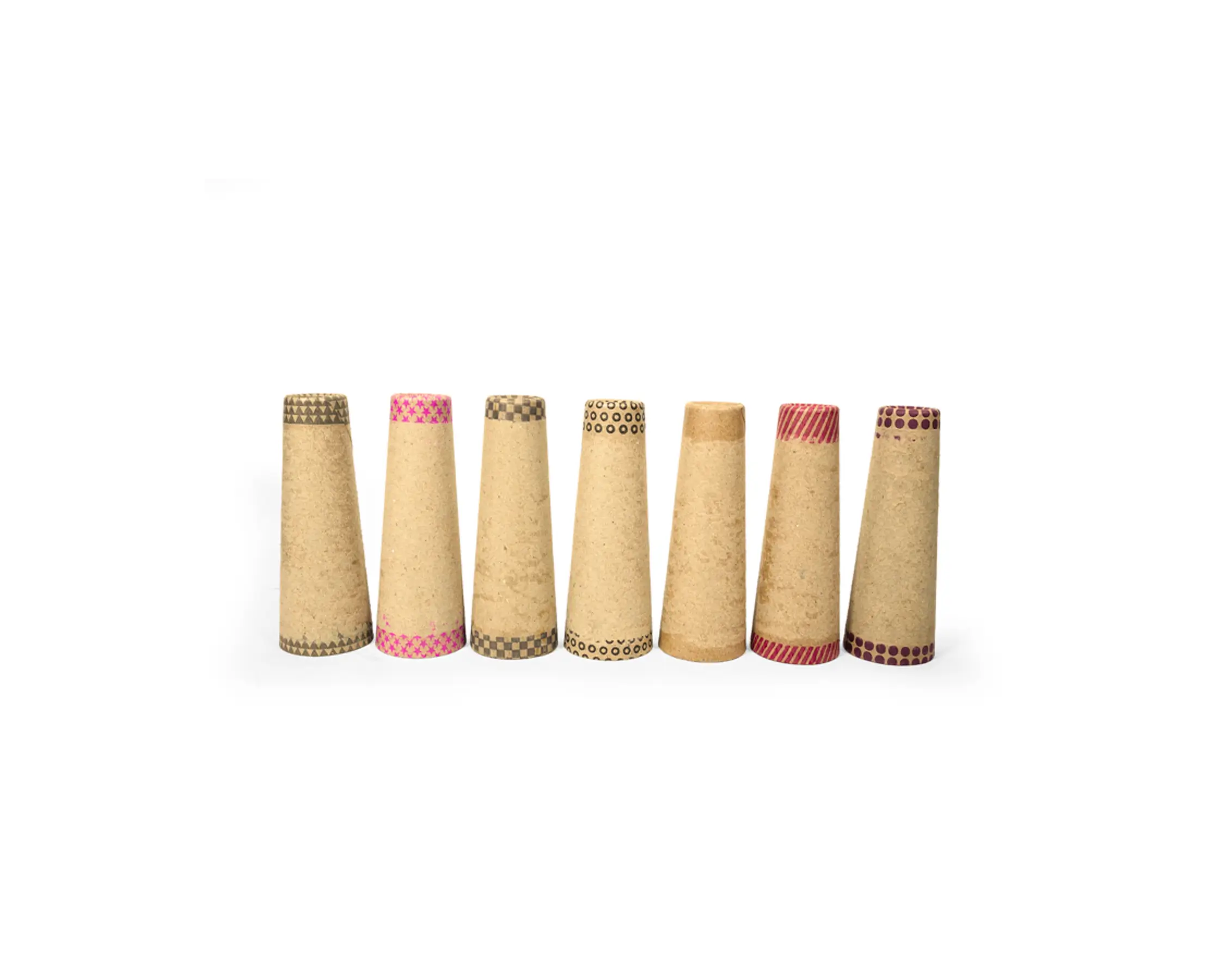
Choosing between a 5° 57' and a 4° 20' cone taper angle is one of the most critical decisions a spinning mill's technical management must make. The taper angle directly influences package geometry, hoop stress resistance, yarn tension gradients, and high-speed unwinding stability on weaving and knitting creels.
1. Understanding Cone Conicity & Taper Geometry
In textile winding, conicity refers to the angle formed between the cone's tapered surface and its central rotational axis. The two most widely used cone angles in global textile manufacturing are 5° 57′ (5 degree 57 minutes) and 4° 20′ (4 degree 20 minutes), standardized internationally under ISO 8489 and Indian Standard IS 4888.
A 5° 57′ cone features a steeper taper angle with a wider bottom inside diameter (typically 68 mm) compared to a 4° 20′ cone (typically 58 mm or 59 mm). This fundamental geometric variance dictates how yarn coils nest along the traverse length during autoconer winding and how packages release yarn during high-speed unwinding.
2. Direct Engineering Specification Comparison
| Parameter | 5° 57′ Standard Cone | 4° 20′ Reinforced Cone |
|---|---|---|
| Applicable Standard | IS 4888 (Part 3) / ISO 8489-5 | IS 4888 (Part 2) / ISO 8489-3 |
| Taper Angle | 5° 57′ ± 5′ | 4° 20′ ± 5′ |
| Standard Length | 170 – 171 mm | 169 – 171 mm |
| Top Inside Diameter | 28 mm | 26 mm / 27.5 mm / 28 mm |
| Bottom Inside Diameter | 68 mm | 58 mm / 59 mm |
| Average Cone Weight | 38 – 50 gm | 35 – 50 gm |
| Radial Crush Resistance | > 750 N | > 780 N (High Hoop Rigidity) |
| Primary Fiber Application | 100% Combed & Carded Cotton | Polyester-Cotton (PC), Modal, Viscose & Synthetics |
| Count Range (Ne) | Ne 20s to Ne 60s (and compact cotton) | Ne 30s to Ne 80s (and fine filament doubling) |
| Target Machinery | Ring spinning autoconers (Savio, Murata, Schlafhorst) | Autoconers, Two-for-One (TFO) twisters, doubling frames |
3. Fiber Mechanics: Cotton vs. Synthetics Under Tension
Why do spinning mills prefer 5° 57′ for pure cotton and 4° 20′ for synthetic and blended yarns? The answer lies in the elastic recovery and mechanical behavior of the wound fibers:
- Cotton Yarns on 5° 57′: Natural cotton fibers possess low elasticity and moderate elongation. When wound on an autoconer, cotton does not exert intense continuous inward compressive force after the package is formed. The steeper 5° 57′ angle allows larger package diameters and rapid tangential yarn release during high-speed circular knitting creel unwinding.
- Synthetics & Blends on 4° 20′: Synthetic fibers like polyester and micro-modal exhibit significant elastic elongation under winding tension. Once wound into a multi-kilogram package, the synthetic yarn continuously contracts inward. A 5° 57′ cone subjected to this relentless hoop pressure can deform, crush, or suffer barrel ovalization. The shallower 4° 20′ taper distributes this compressive stress more uniformly across a narrower diameter, preventing barrel collapse.
4. Creel Unwinding & Autoconer Performance
In high-speed circular knitting and warp beam warping creels, unwinding speeds routinely surpass 1,000 meters per minute. At these speeds:
The 5° 57′ cone facilitates very easy takeoff with minimal unwinding tension peaks. The ballooning profile of yarn exiting a 5° 57′ cone clears the nose cleanly, which is critical for fine-count cotton knitting where yarn strength is lower.
The 4° 20′ cone, being slightly narrower, allows tighter creel spacing on two-for-one (TFO) twisting frames and air-jet weaving creels. Furthermore, for continuous magazine creeling, 4° 20′ cones equipped with deep transfer tail reserve grooves enable seamless automatic transfer from emptying packages to full reserve cones without machine stoppages.
5. Decision Checklist for Mill Procurement Managers
When ordering paper cones from Craftwave & Company, verify the following plant parameters:
- Yarn Composition: If pure cotton, select 5° 57′ cones. If PC blend, polyester, or modal, choose 4° 20′ cones.
- Spindle Mandrel Specifications: Verify your autoconer mandrel taper (Savio, Murata, or Schlafhorst) to ensure exact mechanical fit.
- Crush Resistance Requirements: For high-density packages wound at high winding tension, specify heavy-duty kraft paperboard with radial crush exceeding 750 N.
- Surface Texture: Select velvet flocked finishes to prevent slough-offs on slippery synthetic filaments.
Frequently Asked Questions
Craftwave & Company Technical QA Lab
Manufacturer of high-precision paper cones in Chhapra, Rajkot district, Gujarat, India. Supplying spinning mills across India and global yarn export hubs.
Need Calibrated Paper Cones for Your Spinning Mill?
Request 100 to 500 free trial samples of our 5° 57′ or 4° 20′ paper cones to test dynamic concentricity and crush strength on your high-speed autoconers.